Month: September 2020

  • I don’t feel good about what Marketing has become.

    I don’t feel good about what Marketing has become.

    I’ve been thinking a lot about how I don’t feel good about marketing anymore.

    I’m starting to find out that I’m not the only one.

    Nat Eliason wrote about killing all of his lead magnets.

    There is not a single newsletter I was coerced into joining that I enjoy or have stayed subscribed to.

    I’m starting to feel the same.

    I also discovered a book I had bought in a Humble Bundle, “Rehumanize Your Business,” which is about sending personal emails as a part of your marketing.

    It focuses more on building relationships with clients and potential clients, rather than throwing everything out to see what sticks.

    Which is where marketing currently is.

    Right now, most internet marketing teaching goes like this:

    1. Make content
    2. Add a lead magnet/content upgrade to collect emails
    3. Send weekly emails to newsletter
    4. Sell to those people.

    It’s mostly automated and entirely a numbers game.

    It’s inhuman.

    I am guilty of teaching this stuff, too.

    It does work…but it’s entirely a numbers game.

    It’s built on a concept of throwing everything you’ve got out into the internet and seeing what sticks.

    And then there’s paid advertising.

    We all use Adblockers now, right?

    …anywhere from 18% to 79% of your monthly data bucket can go toward delivering advertising…

    With social media, we know that it’s killing us emotionally.

    How many people are you finding and hiring on social media?

    How many are finding and hiring you?

    One study reported in the American Journal of Epidemiology found that liking more posts was tied to worse mental and physical health and “decreased life satisfaction,” while another study by the University of Copenhagen found that many people suffer from “Facebook envy,” the concept of being jealous of friends’ activities on social media.

    So here’s what my new plan is:

    It starts with Search Engine Optimization (SEO).

    You do keyword and competitor analysis, and then build content out based on that.

    Then you direct people to the email newsletter. But without a lead magnet.

    This requires decent copywriting skills to work well.

    It’s also going to significantly decrease the amount of signups you get.

    This is intentional.

    We want less sign ups who only want the free stuff. We want quality sign ups.

    We want people who sign up because they care about you and what you’re working on.

    It’s going to be significantly less. Be prepared for this.

    Now we’re going to reach out to each one.

    Not an automated welcome sequence. We’re going to look and see every day who signed up.

    Since we’re saving time in the content treadmill, we’re going to spend the newly freed time doing this.

    And we’re going to send them a video.

    It’s a personal video. Eye contact. Say their name. Wave in the beginning. Smile.

    Don’t try to sell. Just introduce yourself. Thank them for joining the list.

    Ask them what they’re struggling with (in regards to your industry).

    After that, you add them to your follow up sequence and newsletter.

    That sequence needs to provide value.

    No sales. Just straight value.

    Don’t make it last longer than a week.

    If your welcome sequence is 3 emails, have one go out every couple days.

    If it’s 5, space them in a way that makes sense.

    For example, maybe emails 1, 2, and 4 have small actions to take. Stuff they can do immediately.

    Email 3 has a medium sized action, something that takes 2 days.

    Email 5 is going to take them a few days.

    So we space out the emails like this: Email1, 1 day later Email2, 1 day later Email3, 2 days later Email4, 1 day later Email5. Then a week before they receive any more emails.

    Any time they reach out to you, a reply to your video or any other email with substance, respond with another video.

    Keep building this personal relationship.

    This will lead high quality sales to you without you having to do anything “icky” or impersonal.

    How does this scale? We’ll talk about that next.

    How to scale it on up

    Just starting out, this shouldn’t take you more than 10 minutes per video.

    If you’re spending more than 10 minutes on the process of recording, uploading, and sending a video…you’re overthinking the whole thing.

    Your video itself shouldn’t be more than 2 minutes.

    Personally, I don’t get so many sign ups every week that I can’t block out enough time to send them all.

    That’s by design.

    But if you do, that’s great too!

    Eventually, you’ll get it down under 10 minutes just from repeating the process.

    But probably not less than 5 minutes. I just don’t think the technology will move that fast for you.

    Just for the sake of argument, let’s say you never get faster than 10 minutes. Worst case scenario.

    If you get 1 signup per day, you can pretty much just knock this out as they come in.

    I recommend you block out a point at the end of your day to do this.

    Just look in your software (I use ConvertKit) and see who signed up.

    1. Record video,
    2. upload video,
    3. send video.

    10 minutes per day…maybe 30 minutes on Monday if you take weekends off but still get subscribers.

    Let’s jump up to 10 per day.

    This is pushing it to almost 2 hours per day.

    If you’re doing the sales part right, you should be getting a pretty good conversion rate from sign ups to clients (or product sales).

    At that point you need to figure out, is it worth it to keep doing this yourself?

    Only you can answer this question based on how much income each signup is worth to your business (I’ll show the equation later on).

    Personally, if I were at that point, I would be hiring help.

    Here’s what I would hire them to do:

    • Send me info of the signups for the day.
    • I would record the videos and them to the assistant.
    • Assistant uploads.
    • Assistant sends.

    That removes me from the aspects that don’t require me.

    Because my brand is ME, I need to be the one in the videos.

    At 100 or more per day, we’re in the big league.

    This is where it might become unscalable for a lot of people.

    There are two reasons here why it might be unscalable:

    1. Whatever you’re selling has too low of a margin to make this worth it.
    2. Your sales sucks and you’re not getting enough.

    Here’s how you figure out if it’s still scalable:

    You take how many subscribers you get and see how many turn into sales.

    If you get 100 subs per day and 60 result in sales, you’re at 60% conversion rate (that’s good).

    Multiply that by the lifetime value of a customer.

    Lifetime value is how much value you expect to get out of one customer.

    If you sell one ebook at $9.99 then that’s the lifetime value…9.99.
    If you sell a $1000 service w/ an optional $100/month package, and you have 60 customers but only 30 of them pick up the optional package, with 15 doing 6 months and 15 doing only 3 months, you gotta do some math.

    I’m gonna be a little harsh…this is pretty basic algebra. If you can’t do the math, get an accountant or maybe you shouldn’t be in business.
    I almost didn’t graduate high school because I failed Algebra 2 and then I almost failed out of college for failing the same dang class. If I can do this math, you either can or know someone who can help you.

    I mean heck email me the info and I’ll do the math for you. I don’t mind.

    Anyway the answer to the above equation is that we have 15 customers worth $1600, 15 customers worth $1300, and 30 customers worth $1000. Average them out and we get ((1600 * 15) + (1300 * 15) + (1000 * 30) / 60 )= ((24,000 + 19,500 + 30,000) / 60) = 73,500 / 60 = $1225.

    $1225 is the lifetime value of a customer.

    Once you figure out the lifetime value of a customer, you can then compare with how long it takes you to make the video, how long it takes your assistant to get it out there and how much you’re paying them.

    You figured out it is still scalable. Now what?

    If you’re getting over 100 subscribers per day with a decent conversion to sales, you should consider removing yourself as the face that sends videos.

    Instead, hire community managers (for products) or account managers (for services) to handle it.

    At that point you should have people who’s entire job is to work with your customers/clients directly.

    Now, you’re not a solo-preneur with an assistant…you’re an agency.

    Put some experienced people in charge of the accounts and train them to send the videos.

  • Everything I’ve Learned From Eddie Shleyner

    Everything I’ve Learned From Eddie Shleyner

    Eddie Shleyner is the Lead Copywriter at G2.com & Founder of VeryGoodCopy.com.

    Notes from his micro-courses coming soon…

    How to grow your social media following over 10k in under a year:

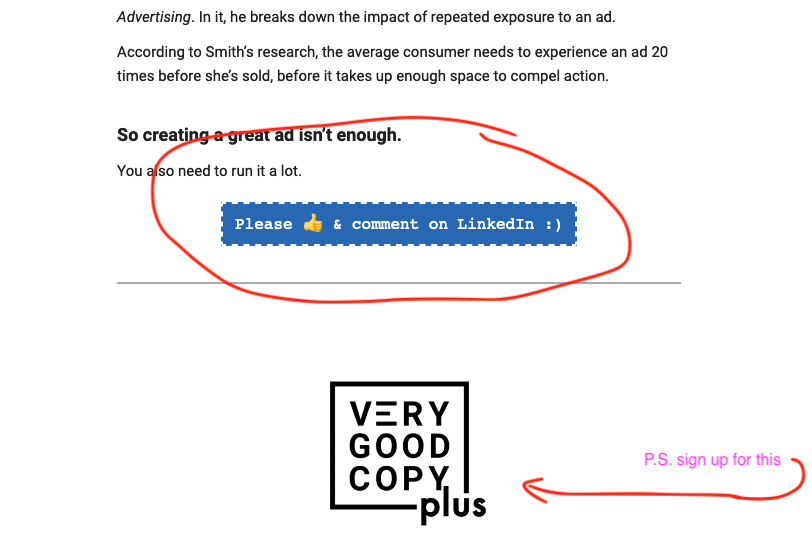
    If you look at any email Eddie sends (usually from VeryGoodCopy), there’s a button that asks you to like a post on LinkedIn.

    It looks like this:

    A screenshot of one of Eddie Shleyner's emails that has a LinkedIn button in it.
    Sign up for his VGC Plus. It’s awesome.

    That’s it. It’s that simple.

    You can do that with any social media you have.

    It doesn’t have to be LinkedIn.

    All you gotta do is ask.

  • Garrett’s “I Only Need One” Method to Making Big Bucks

    Garrett’s “I Only Need One” Method to Making Big Bucks

    My dad goes to a lot of trade shows. One year he saw one booth that was a guy with a fold-out table. Nothing special.

    There was a sign that said “Consulting: $100,000”.

    My dad walked up and asked him, “Does this actually work?”

    And the guy replied, “I only need one.”

    2021 Update: my dad informed me it’s actually a TV commercial.

    In Overlap, Sean teaches us that we need to get to a new normal of 6 months of expenses in the bank.

    At that point, you can quit the day job and change the Overlap to the Career.

    According to The Street, the average income in the USA is just under $50,000 a year.

    I don’t like to do a minimum of 6 months’ expenses. I like to do a minimum of 6 months of lifestyle.

    So, let’s say that’s $25,000.

    Now, you need a service. Something that’s going to make your client money.

    Maybe you sell it for $1000. You need 25 clients to get there.

    What if you sell it for $25,000? Then you “only need one”.

    Going by Overlap, you should expect to work at your day job for 2 years before you reach that point to quit.

    Obviously, your single big-ticket item needs to provide well over $25,000 worth of value to a client.

    Is there something you can do that is worth that much to the right client?

    Don’t think about “well I mostly market to Etsy sellers and most of them don’t make that much money.”

    Instead, think “well I mostly market to Etsy sellers but there are other industries where I could provide $25,000 worth of value. And they can pay it.”

    Then you only need one. In 2 years.

    In 2 years of Overlapping, can you find ONE company that would pay $25,000 for your service?

    Year 3: $50,000
    Year 4: $100,000
    Year 5: $1,000,000

    10x your ex’s 10x (and make them wish you hadn’t split up).

    For $25,000, I can help you become a brand people are proud to buy from.

  • Everything I’ve Learned from David Ogilvy

    Everything I’ve Learned from David Ogilvy

    David Ogilvy is one of the most famous ad and copywriters in history. I’m pretty sure the character Don Draper from Mad Men is based on him.

    “Big ideas come from the unconscious. This is true in art, in science and in advertising. But your unconscious has to be well informed, or your idea will be irrelevant. Stuff your conscious mind with information, then unhook your rational thought process. You can help this process by going for a long walk, or taking a hot bath, or drinking half a pint of claret.”

    David Ogilvy

  • Everything I’ve Learned From Cole Schafer

    Everything I’ve Learned From Cole Schafer

    Cole Schafer is a copywriter who runs a company called Honey Copy.

    …our weaknesses don’t take away from our strengths, they inform them.

  • Conversion Class Micro Course Review and Notes

    Conversion Class Micro Course Review and Notes

    Conversion Class Micro Course by VeryGoodCopy Review

    10/10 will read over and over again.

    This micro-course is a fantastic primer for newcomers to copywriting, and full of great reminders for those who have been writing for years.

    Also, the idea of micro courses is brilliant and I’m absolutely going to rip that off.

    Conversion Class Micro Course by VeryGoodCopy Notes

    Coming soon.

  • 30 Days to Better Writing Notes

    30 Days to Better Writing Notes

    30 Days to Better Writing is was a course by Sean McCabe of seanwes.

    Update 2022: Sean McCabe has taken the course down and disappeared. I could not complete it in time to get a full set of notes. RIP.

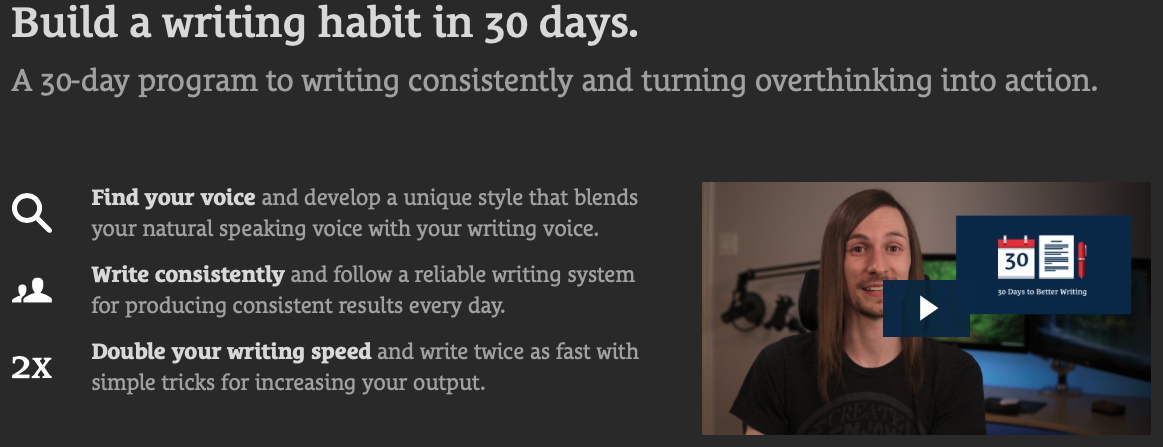
    The course objective is to build a writing habit in 30 days of consecutive daily writing.

    Each day, Sean includes tips and advice, and optional writing prompts.

    I’ve gone through this multiple times and enjoyed it every time.

    I am taking and sharing my notes this time to help me internalize them.

    Day 1 Stats

    • Word Count: 1270
    • Comments: Was a good brain dump. Got out lots of ideas I can build upon and act on. Mostly for the day job.

    Notes

    Any ideas we don’t write down will die when we die.

    Writing something down increases the likelihood of it happening.

    Writing is the starting point of all other mediums

    • Speeches
    • Products
    • Songs
    • Books
    • Podcasts, etc

    It all starts with writing.

    Writing is a skill that can be developed, and one of the most important skills available to humans.

    If the best athletes train daily to improve their abilities, so should writers.

    If you’re not good at writing now, that’s okay. You can learn.

    Anything you care about and want to improve at must be practiced daily.

    You don’t have to publish daily. You don’t have to share everything you write. But you must write.

    Writing…

    • clears your mind
    • improves your speaking
    • improves how people see you
    • can grow your audience
    • can put your name on the map

    Commit to writing daily. It must be scheduled.

    Chain writing to another habit.

    Example: After waking up, make coffee. Once coffee is ready, sit down and write.

    Sean suggests starting for 20 minutes per day.

    Set goals as time instead of word count.

    It doesn’t need to be perfect. Don’t worry about spelling or grammar or anything else.

    Just write.

    Set a timer for 20 minutes and write until it goes off.

    Sean offers the following writing prompts:

    • What made you enroll in this course?
    • What are 3 ways you think writing will benefit you?
    • What are you afraid of when it comes to writing?
    • What sacrifices will you have to make in order to carve out half an hour a day for writing?

    Day 2 Stats

    • Word Count: 1226
    • Comments: Another good stream of consciousness…did some planning and got some clarity. Used the writing prompts.

    Notes

    Getting started is the hardest part…but once you get started it’s easy to keep going.

    One problem is that you don’t schedule the writing, which gives you the “freedom” to put it off.

    Also schedule the end…the limited time helps.

    Too many options, too much time, and too much freedom will paralyze you.

    Don’t worry about the first words being the right words. They won’t be.

    Write all of the words, right and wrong. Delete the wrong words later.

    You can’t edit what you haven’t written.

    Start with stream of consciousness writing: write down every thought.

    This bridges the connection between your mind, fingers, keyboard, and document.

    Don’t worry about whether or not it makes sense. It doesn’t matter if it’s relevant.

    Sean’s writing prompts for the day:

    • What is one of your favorite things to do outside of work when you have free time?
    • What do you enjoy most about this activity?
    • Why have you not dedicated more time to this activity?
    • Do you think that’s a good excuse?
    • What do you propose to do differently or sacrifice so that you can spend more time doing the things you enjoy?

    Day 3 Stats

    • Word Count: ~250
    • Comments: Wrote significantly less today BUT that’s because instead of stream of consciousness writing and/or following prompts, I decided I needed to get some rough outlines of my processes down. This is a very important task I’ve been putting off for some time.

    Notes

    Start your day with writing.

    Plan your topic for tomorrow, the night before.

    You won’t have to waste time trying to figure out what to write about.

    Your brain will get started processing the topic.

    Getting your writing done first thing means you’re coming off the charge of sleep.

    Kind of like what Mark Twain (I think?) said about eating the biggest frog first.

    This also reminds me of something Sean said a while back…what you do first in the day shows your priorities.

    If you save writing as the last thing, you’re setting it as a low priority.

    But this is 30 Days To Better Writing, so obviously we’re making writing the priority.

    Sean recommends waking up early.

    I don’t agree that is the key…as Tim Ferriss says in his book Tools of the Titans (BJ Novak chapter), “For lifelong night owls like me, it’s nice to know that when you get started each day seems to matter less than learning how to get started consistently, however your crazy ass can manage it.”

    I have found that I do my best writing first thing in the day, and in an interruption-free setting.

    It doesn’t matter if that’s at 6 AM or 9 AM, as long as it’s first and distraction free.

    YMMV; it’s up to you to figure out what works best for you.

    Sean was able to write millions of words in a year “with a daily commitment and a decision to maximize my output by writing at the most productive time.”

    Don’t shortchange yourself by writing at a time where you write less!

    Here’s my steps to figure out when you write better, adapted from Sean’s advice:

    1. Write whenever you want for 7 days straight.
    2. Log your output — time spent and words written.
    3. Commit to waking early for just one week.
    4. Write as the first thing you do in the morning.
    5. Log your output.
    6. Do the same for writing at various other times of the day.
    7. Compare your results.

    Included writing prompts:

    • Write about how much you hate waking up early.
    • Write about your plan to start waking up early.
    • Write about the benefits you’ve seen from waking up early.
Secret Link