Blog

  • Conversion Class Micro Course Review and Notes

    Conversion Class Micro Course Review and Notes

    Conversion Class Micro Course by VeryGoodCopy Review

    10/10 will read over and over again.

    This micro-course is a fantastic primer for newcomers to copywriting, and full of great reminders for those who have been writing for years.

    Also, the idea of micro courses is brilliant and I’m absolutely going to rip that off.

    Conversion Class Micro Course by VeryGoodCopy Notes

    Coming soon.

  • 30 Days to Better Writing Notes

    30 Days to Better Writing Notes

    30 Days to Better Writing is was a course by Sean McCabe of seanwes.

    Update 2022: Sean McCabe has taken the course down and disappeared. I could not complete it in time to get a full set of notes. RIP.

    The course objective is to build a writing habit in 30 days of consecutive daily writing.

    Each day, Sean includes tips and advice, and optional writing prompts.

    I’ve gone through this multiple times and enjoyed it every time.

    I am taking and sharing my notes this time to help me internalize them.

    Day 1 Stats

    • Word Count: 1270
    • Comments: Was a good brain dump. Got out lots of ideas I can build upon and act on. Mostly for the day job.

    Notes

    Any ideas we don’t write down will die when we die.

    Writing something down increases the likelihood of it happening.

    Writing is the starting point of all other mediums

    • Speeches
    • Products
    • Songs
    • Books
    • Podcasts, etc

    It all starts with writing.

    Writing is a skill that can be developed, and one of the most important skills available to humans.

    If the best athletes train daily to improve their abilities, so should writers.

    If you’re not good at writing now, that’s okay. You can learn.

    Anything you care about and want to improve at must be practiced daily.

    You don’t have to publish daily. You don’t have to share everything you write. But you must write.

    Writing…

    • clears your mind
    • improves your speaking
    • improves how people see you
    • can grow your audience
    • can put your name on the map

    Commit to writing daily. It must be scheduled.

    Chain writing to another habit.

    Example: After waking up, make coffee. Once coffee is ready, sit down and write.

    Sean suggests starting for 20 minutes per day.

    Set goals as time instead of word count.

    It doesn’t need to be perfect. Don’t worry about spelling or grammar or anything else.

    Just write.

    Set a timer for 20 minutes and write until it goes off.

    Sean offers the following writing prompts:

    • What made you enroll in this course?
    • What are 3 ways you think writing will benefit you?
    • What are you afraid of when it comes to writing?
    • What sacrifices will you have to make in order to carve out half an hour a day for writing?

    Day 2 Stats

    • Word Count: 1226
    • Comments: Another good stream of consciousness…did some planning and got some clarity. Used the writing prompts.

    Notes

    Getting started is the hardest part…but once you get started it’s easy to keep going.

    One problem is that you don’t schedule the writing, which gives you the “freedom” to put it off.

    Also schedule the end…the limited time helps.

    Too many options, too much time, and too much freedom will paralyze you.

    Don’t worry about the first words being the right words. They won’t be.

    Write all of the words, right and wrong. Delete the wrong words later.

    You can’t edit what you haven’t written.

    Start with stream of consciousness writing: write down every thought.

    This bridges the connection between your mind, fingers, keyboard, and document.

    Don’t worry about whether or not it makes sense. It doesn’t matter if it’s relevant.

    Sean’s writing prompts for the day:

    • What is one of your favorite things to do outside of work when you have free time?
    • What do you enjoy most about this activity?
    • Why have you not dedicated more time to this activity?
    • Do you think that’s a good excuse?
    • What do you propose to do differently or sacrifice so that you can spend more time doing the things you enjoy?

    Day 3 Stats

    • Word Count: ~250
    • Comments: Wrote significantly less today BUT that’s because instead of stream of consciousness writing and/or following prompts, I decided I needed to get some rough outlines of my processes down. This is a very important task I’ve been putting off for some time.

    Notes

    Start your day with writing.

    Plan your topic for tomorrow, the night before.

    You won’t have to waste time trying to figure out what to write about.

    Your brain will get started processing the topic.

    Getting your writing done first thing means you’re coming off the charge of sleep.

    Kind of like what Mark Twain (I think?) said about eating the biggest frog first.

    This also reminds me of something Sean said a while back…what you do first in the day shows your priorities.

    If you save writing as the last thing, you’re setting it as a low priority.

    But this is 30 Days To Better Writing, so obviously we’re making writing the priority.

    Sean recommends waking up early.

    I don’t agree that is the key…as Tim Ferriss says in his book Tools of the Titans (BJ Novak chapter), “For lifelong night owls like me, it’s nice to know that when you get started each day seems to matter less than learning how to get started consistently, however your crazy ass can manage it.”

    I have found that I do my best writing first thing in the day, and in an interruption-free setting.

    It doesn’t matter if that’s at 6 AM or 9 AM, as long as it’s first and distraction free.

    YMMV; it’s up to you to figure out what works best for you.

    Sean was able to write millions of words in a year “with a daily commitment and a decision to maximize my output by writing at the most productive time.”

    Don’t shortchange yourself by writing at a time where you write less!

    Here’s my steps to figure out when you write better, adapted from Sean’s advice:

    1. Write whenever you want for 7 days straight.
    2. Log your output — time spent and words written.
    3. Commit to waking early for just one week.
    4. Write as the first thing you do in the morning.
    5. Log your output.
    6. Do the same for writing at various other times of the day.
    7. Compare your results.

    Included writing prompts:

    • Write about how much you hate waking up early.
    • Write about your plan to start waking up early.
    • Write about the benefits you’ve seen from waking up early.
  • 48 Laws of Power Review, List, and Notes

    48 Laws of Power Review, List, and Notes

    48 Laws of Power by Robert Greene Review

    I haven’t read this yet, but it’s on the list.

    I’m going to be honest…based on the list I pulled…the Buddhist in me is not excited.

    I don’t think many of these are the types of things I care to do.

    That said, these are things people are doing to us.

    Whether or not we want to follow these 48 Laws of Power, it’s good to be aware for when people are using them on us.

    48 Laws of Power List

    1. Never outshine the master
    2. Never put too much trust in friends, learn how to use enemies
    3. Conceal Your Intentions
    4. Always say less than necessary
    5. So much depends on reputation, guard it with your life
    6. Court attention at all costs
    7. Get others to do the work for you, but always take the credit
    8. Make other people come to you, use bait if necessary
    9. Win through your actions, never through argument
    10. Infection: Avoid the unhappy or the unlucky
    11. Learn to keep people dependent on you
    12. Use selective honesty and generosity to disarm your victim
    13. When asking for help, appeal to people’s self-interest, never their mercy or gratitude
    14. Pose as a friend, work as a spy
    15. Crush your enemy totally
    16. Use absence to increase strength and honor
    17. Keep others in suspended terror, cultivate an air of unpredictability
    18. Do not build a fortress to protect yourself, isolation is dangerous
    19. Know who you’re dealing with, do not offend the wrong person
    20. Do not commit to anyone
    21. Play a sucker to catch a sucker, seem dumber than your mark
    22. Use the surrender tactic: transform weakness into power
    23. Concentrate your forces
    24. Play the perfect courtier
    25. Re-Create Yourself
    26. Keep your hands clean
    27. Play on people’s need to believe to create a cult-like following
    28. Enter action with boldness
    29. Plan all the way to the end
    30. Make your accomplishments seem effortless
    31. Control the options, get others to play with the cards you deal
    32. Play to people’s fantasies
    33. Discover each man’s thumbscrew
    34. Be royal in your own fashion. Act like a king to be treated like one
    35. Master the art of timing
    36. Disdain things you cannot have, ignoring them is the best revenge
    37. Create compelling spectacles
    38. Think as you like but behave like others
    39. Stir up waters to catch fish
    40. Despise the free lunch
    41. Avoid stepping into a great man’s shoes
    42. Strike the shepherd and the sheep will scatter
    43. Work on the hearts and minds of others
    44. Disarm and infuriate with the mirror effect
    45. Preach the need to change, but never reform too much at once
    46. Never appear too perfect
    47. Do not go past the mark you aimed for. In victory, know when to stop
    48. Assume formlessness

    48 Laws of Power Notes by Chapter

    These are not just “Cliff’s notes” style.

    I include my own thoughts and examples of how I’m applying it to my life.

    Coming Soon…

  • Everything I’ve Learned from Eugene Schwartz

    Everything I’ve Learned from Eugene Schwartz

    I’ve learned a lot from the famous Copywriter Eugene Schwartz.

    Studying the greats before you is a great way to learn.

    It’s my favorite way to learn.

    Eugene Schwartz’s Headline Formula

    I saw this pointed out on Copy Skillz YouTube channel and it hits the nail on the head.

    Eugene Schwartz often uses a headline formula: Proof + Pain + Benefit, in that order.

    A lot of his headlines are very long.

    They were used primarily in Print advertising, so he had space.

    Working on the internet now, we don’t have that luxury.

    Regardless, the formula still works.

    These examples show it working:

    Now, medical science has the power to say to you:

    Follow these 3 simple steps and,

    BEGIN YOUR “MIDDLE YEARS” AT 70, 80, EVEN 90!

    This one fits the formula easily.

    It came broke into those 3 lines in the ad, but each line shows each part of the formula.

    The Proof is medical science.

    The Pain is on the second line: processes are tough, but not in this case. This is three simple steps.

    The Benefit is on the third line: “middle years” or “middle age” getting pushed back from 40-50 to 70, 80, even 90.

    A Eugene Scwartz ad that says, "How modern Chinese Medicine helps both men and women BURN DISEASE OUT OF YOUR BODY...lying flat on your back, using nothing than the palm of your hand!"

    How modern Chinese Medicine helps both men and women

    BURN DISEASE OUT OF YOUR BODY

    …lying flat on your back, using nothing than the palm of your hand!

    The Proof, again, is the medical part. “Chinese Medicine” in this case.

    The Pain, again, is in how simple the action is. Normally, burning disease out of your body would be hard work. Not this. This is easy.

    And the Benefit, on line 2, is burning the disease out of your body.

    Favorite Eugene Schwartz Quotes:

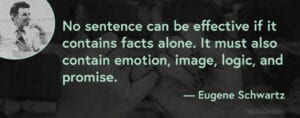
    “No sentence can be effective if it contains facts alone. It must also contain emotion, image, logic, and promise. “

    Eugene Schwartz

    Copy is not written. If anyone tells you ‘you write copy’, sneer at them. Copy is not written. Copy is assembled. You do not write copy, you assemble it. You are working with a series of building blocks, you are putting the building blocks together, and then you are putting them in certain structures, you are building a little city of desire for your person to come and live in.

    Eugene Schwartz

    The greatest mistake marketers make is trying to create demand.

    Eugene Schwartz

    This is the copywriters task: not to create mass desire — but to channel and direct it.

    Eugene Schwartz

    What you are doing when you are being creative is trying to connect two separate ideas that logically would not go together up until that moment.

    Eugene Schwartz

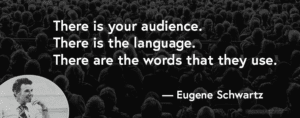
    There is your audience. There is the language. There are the words that they use.

    Eugene Schwartz

    “You can’t take nothing and make anything. You’re not God.”

    Eugene Schwartz
  • Real Artists Don’t Starve Review and Notes

    Real Artists Don’t Starve Review and Notes

    Real Artists Don’t Starve by Jeff Goins Review

    10/10 would read again.

    This book, plus Overlap by Sean McCabe, are the two books I recommend anyone start with who are beginning to make path of their own.

    Although “artists” is in the title, this really applies to anyone who wants to be an entrepreneur and start their own business.

    Real Artists Don’t Starve Notes by Chapter

    These are not just “Cliff’s notes” style.

    I include my own thoughts and examples of how I’m applying it to my life.

    Introduction – The Myth of the Starving Artist

    Jeff Goins starts off talking about how Michelangelo, the artist known for painting the Sistine Chapel, was actually wealthy.

    He was worth what would be about $47 million today.

    That’s the top 1%, right?

    I believed in the Myth of the Starving Artist

    I’ve wanted to be a musician since I was very young, it was kind of my first love, I guess.

    And people always told me to have a fallback because they believed the Starving Artist Myth.

    So I didn’t pursue that as a career path because everybody told me there was no way to be a musician successfully.

    I didn’t even really practice guitar that much because, to me, it was just a silly hobby.

    Then when I was 17 or 18, I started my first “media company.”

    I want to put media and company in quotes together and separately because it wasn’t really officially a company, and media is sort of an ambiguous term.

    But this was when I was 17 or 18, and I was taking photos and doing some graphic design and web design for local bands.

    What does it mean to be a real artist?

    Goins says, “it means we spend our time working on what matters most to us and that we don’t need anyone’s permission to create. “

    That’s the life that I want. And that’s the life that I am building with No Alarms Club.

    Thriving Artists in the New Renaissance

    Goins uses the terms, “New Renaissance” and “Thriving Artists” to define and describe what we are working to achieve here.

    So he has 12 rules that we should live by.

    I hope he doesn’t mind giving this part of the book away.

    I do highly recommend you purchase this book and read it yourself. It’s fantastic.

    So the 12 principles every Thriving Artist lives by, or the New Renaissance as he calls them.

    1. The starving artist believes you must be born an artist. The thriving artist knows you must become one.
    2. The starving artist strives to be original. The thriving artist steals from his influences.
    3. The starving artist believes he or she has enough talent, the thriving artist apprentices under a master.
    4. The starving artist is stubborn about everything. The thriving artist is stubborn about the right things.
    5. The starving artist waits to be noticed. The thriving artist cultivates patrons.
    6. The starving artist believes they can be creative anywhere. The thriving artist goes where creative work is already happening.
    7. The starving artist always works alone. The thriving artist collaborates with others.
    8. The starving artist does his work in private, the thriving artist practices in public.
    9. The starving artist works for free. The thriving artist always works for something.
    10. The starving artist sells out too soon. The thriving artist owns their work.
    11. The starving artist masters one craft. The thriving artist masters many.
    12. The starving artist despises the need for money. The thriving artist makes money to make art.

    I wrote some notes down on each one of these.

    The first one, the starving artist believes you must be born an artist. The thriving artist knows you must become one.

    This is definitely true. You can practice and learn pretty much any skill.

    I definitely don’t think I was born with any skills.

    I’ve had friends throughout my life that seemed to have been born with innate skills.

    When I was in elementary school, I had a friend named Charles, who was very good at drawing.

    And I know he practiced a lot, but he also seemed to have some sort of innate skill that he was born with.

    Another friend of mine, from high school, Adam, is a fantastic musician, and I know he also practiced a lot. Still, it just seemed like he grasped the concept so much easier than I ever did.

    There are definitely things that now, in my thirties, I feel like I am good at, but I don’t feel like there was anything I was born good at. These are all things that I have practiced.

    Particularly writing. Writing, I think, is my strongest skill.

    I’m also really good with people.

    Under the second principle, the starving artist strives to be original. The thriving artist steals from his influences.

    I don’t really have anything written down much for this.

    I definitely am going to need to read this chapter to understand it more.

    I did write down that this reminds me, I should read Austin Kleon’s books.

    He wrote a book called Steal Like An Artist.

    As well as some other books within that realm of knowledge.

    Number three, the starving artist believes he has enough talent. The thriving artist apprentices under a master.

    This is kind of terrifying to me. Finding a mentor is tough.

    So I’m looking forward to reading this chapter, and I hope that Goins explains a comfortable way to do this.

    Four, the starving artist is stubborn about everything. The thriving artist is stubborn about the right things.

    I’m interested in learning more about the right and wrong things to be stubborn because I am concerned that I perhaps am stubborn about the wrong things instead of the right things.

    So I’m looking forward to that chapter as well.

    Five, the starving artist waits to be noticed. The thriving artist cultivates patrons.

    I am betting that this has something to do with social media.

    And we will find out when we get there.

    Six, the starving artist believes he can be creative anywhere. The thriving artist goes where creative work is already happening.

    I’m hoping that this doesn’t mean I have to move because I actually like where I live.

    Number seven, the starving artist always works alone. The thriving artist collaborates with others.

    Collaboration is great, but I often have trouble finding like-minded people.

    I think that some of that might be that I am too much of a control freak when it comes to my art and things that I create.

    Maybe I should just start collaborating with anybody I can, only to expose myself to different art.

    So that chapter should help me quite a bit.

    Eight, the starving artist does his work in private. The thriving artist practices in public.

    I also feel like this might be about using social media.

    But I guess we’ll see when we get there.

    Number nine, the starving artist works for free. The thriving artist always works for something.

    I guess we’ll find out when we get there, what something means, but one thing that I live by is: never work for free and don’t work for exposure because that’s kind of a BS thing.

    10, the starving artist sells out too soon. The thriving artist owns his work.

    I’m hoping that this has something to do with licensing.

    Licensing art is something that’s always been fascinating to me.

    I first learned about it in high school.

    A band that I listened to, Mindless Self Indulgence, instead of signing to a record label, license their music to record labels.

    They still own the music but had the marketing power of a record label behind them.

    They went on to be quite successful.

    11, the starving artist masters one craft. The thriving artist masters many.

    This really speaks to me as someone who enjoys creating art through many different mediums.

    I like making music. I love working with video. I like working with graphics. I like recording podcasts. I like writing.

    I love writing. It’s my second love after music.

    As someone who is always craving to create new things through many different mediums, I’m hoping that this chapter 11 reinforces what I feel deep inside about wanting to just create across as many different mediums as I possibly can.

    And number 12, the starving artist despises the need for money. The thriving artist makes money to make art.

    This one will require a bit of a mindset shift for me.

    I kind of despise the need for money, and I generally have lost faith in people to maintain sustainable capitalism.

    I’m not against capitalism necessarily. I just feel that what is sustainable capitalism is not where America is headed.

    I’m concerned that we are drifting further and further from a sustainable economy in America and more towards a greed-based economy that is just not going to work out.

    And because of that, we’re going to end up in a situation where nobody’s happy.

    But I’ll leave the economics, politics, and social issues to a different podcast.

    I want to end this chapter with one more thing.

    Jeff Goins says being a starving artist is a choice. And I do believe that.

    In my over a decade of experience working on the internet, specifically at marketing, I have come to the conclusion that you can pretty much make money with almost anything on the internet.

    Chapter 1 – You Aren’t Born An Artist

    This book is split into three sections, and the first section of the book is about mindset.

    From Baseball to Writing

    This chapter starts with a story about a major league baseball player, Adrian Cardinez. He played for the Phillies, and then the Chicago Cubs.

    I don’t really know much about baseball.

    I’m not a big baseball fan, but the story is interesting nonetheless.

    He was really good at baseball as a kid and a teenager and was drafted right out of high school.

    When he signed to the Cubs, he had a high player salary and a signing bonus of almost a million dollars, but he was not happy.

    He found that he wasn’t like the other players.

    For example, while his fellow players were out partying, he read Tolstoy. He played piano for his friends in small intimate settings.

    Within a year of being signed to the major league, he left to pursue a career in writing.

    A form of art that he truly loved.

    So far, this chapter is really speaking to me.

    It’s okay to reinvent who we are.

    I spent over the last decade working in internet marketing through various industries. And I don’t really want to do it anymore.

    I don’t mind marketing my own stuff, and I don’t mind helping other people learn to do their own marketing.

    Still, I don’t want to do marketing for other people or other companies anymore.

    I just don’t find joy in that anymore.

    To help with that, I created the No Alarms Club podcast.

    It started off as a podcast where I go through books and share my experience learning from them.

    Now, I’m considering adding a repository of all of my marketing knowledge and experience.

    I’d put all of it into one website. I’d update it as I think of new things to add.

    I’d also add some checklists and step-by-step stuff so that you can just kind of follow the list.

    It indeed would be all of my knowledge and experience put into one repository.

    I will work on it as long as it takes for me to get everything out of my head and written down for others to use.

    I also believe that it is my ticket to a No Alarms Club lifestyle.

    But eventually, I’d like to have someone else handling that and just sit back and create art of various kinds.

    In the last chapter, I discussed how, in chapter 11, we are going to be considering creating art through many different mediums.

    And that is something that I really look forward to spending my time doing.

    But that’s quite a few episodes away.

    In this chapter, Goins says, “we aren’t born an artist. We become one.”

    He calls this the Rule of Re-Creation.

    Goins says it’s okay for us to “change the script” that we live and pursue something else.

    That’s where I’m at right now.

    I currently have a day job.

    I work for a nonprofit trade association called the American Institute of Building Design.

    I do enjoy the job.

    I like all of the people that I work with.

    I like interacting with our members, and I love going to the events and especially our new online activities.

    I have a lot of fun with that.

    But I’m ready for something new.

    I want total freedom and passive income.

    The next part of this chapter talks about becoming an artist.

    People believe we are either born with artistic talent or not.

    Some people seem to be. But the truth is any of us can learn it.

    I also mentioned this in the last episode.

    I had a friend in elementary school named Charles, who was really fantastic at drawing.

    To this day, I believe he was born with some level of artistic talent. But I also know that he practiced a lot.

    Then in high school, a good friend of mine named Adam is fantastic at music, and he also seemed to be born with it, but I know that he practiced a lot as well.

    It takes hard work and dedication for most of us to become good at something.

    I was not born with any particular artistic talent.

    But I was born with a drive to create.

    I enjoyed writing and drawing a lot as a kid, as well as music.

    But because I was taught and myself believed the myth of the starving artist, I didn’t pursue any artistic trades.

    For the most part, my family and everyone else I knew told me that it was nearly impossible to succeed as an artist.

    I ended up going into internet marketing for more than a decade of my adult life, which is where I am now.

    I started a company a couple of years ago called Approaching Utopia.

    It has many incarnations, but the current idea is that it’s a media company producing ebooks, videos, and more based on technology’s ethics.

    Obviously, I can’t do all the different types of media myself, and that’s fine. I don’t need to.

    But starting out, I need at least something to offer.

    There is one podcast, Your Secure Life, that I need to get back to.

    The idea is to monetize that podcast by releasing a yearly book of privacy and cybersecurity tips for the average person.

    I’ve been working on a couple podcasts for over a year now.

    I’ve worked on several other podcasts in the past, which no longer exist.

    I still have quite a bit of learning about podcasting, but that’s the nature of any artistic endeavor.

    There’s always going to be something new to learn and something to improve.

    Also, I just love podcasting.

    I’ve also picked up books and online courses about web design and development, branding, UX, and UI, graphic design, photography, and video work throughout my adult life.

    I don’t need to be an expert nor even really that good at all of these.

    Still, if I’m running a media company, it’s important to me that I know enough.

    When I hire someone to handle each of those tasks, I want to understand what they’re doing, why they’re doing it, what they’re saying when describing things to me, and so on.

    It’s vital to me not to be “that CEO” who doesn’t know what the heck my hired creatives are talking about and doing.

    I also want to be able to contribute if a project needs it.

    There’s a picture online that I like. I’ll post it at NoAlarmsClub.com/2.

    And to describe it basically, there are two parts.

    There is a picture of a few people pulling a desk with a guy sitting on top of the desk, pointing forward.

    That one is captioned “boss.”

    Underneath that is a picture of all of those same people pulling the desk.

    Instead of the guy on top of the desk, he’s in front pulling with them.

    That one is captioned “leader.”

    That’s who I want to be.

    I want to sit down when necessary and help any of my creatives finish projects for our clients.

    From Marketing to Writing

    Goins tells a story in this chapter that is really relatable for me. It’s very familiar.

    Goins says he worked as a marketing director for a nonprofit when he decided he didn’t want to work in marketing anymore.

    That’s almost exactly my story.

    He says he started calling himself a writer, which was the next path he wanted to take with his life.

    So, what do I call myself?

    What is the next path that I want to take?

    I need to figure this out.

    But again, that’s what all this is about, right?

    It’s going to get me there.

    An Introduction to Overlapping

    Next, Goins tells a story about John Grisham, who is a well known legal thriller author.

    I think I’ve read at least one of his books.

    He wrote his first book one page per day before starting his day job.

    He had a wife and a newborn child.

    It would have been reckless to just quit his day job and start writing.

    So he wrote in the mornings before he went to work.

    There is an online entrepreneur I follow named Sean McCabe. He wrote this excellent book called Overlap.

    That is the next book we’re going to cover on the No Alarms Club podcast after we finish Real Artists Don’t Starve.

    This is something he calls Overlapping, which is when you have a day job but are working on what he calls your Overlap. It’s Overlapping specifically when you intend to move into that professionally.

    Back to Real Artists Don’t Starve, Goins says, “we don’t fake it til we make it. We believe it until we become it.”

    Working on something little bits every day may seem small and insignificant, but it really does add up.

    And it’s better to spend a few minutes here and there than to wait for time to sit down and do, for example, a whole hour.

    Overlapping leads to success.

    A study at the University of Wisconsin found that entrepreneurs who kept their day jobs and overlapped were more successful.

    Those that quit their jobs to go all-in were 33% more likely to fail.

    I don’t want to fail. I don’t think most people want to fail.

    I’d like to get any bit of help that I can because all of that help adds up.

    If people who Overlap are more successful, then I’m going to Overlap.

    Write your own job title.

    The next story in this chapter talks about a guy who worked at Hallmark, the greeting cards company.

    He sort of created his own department and job title, doing precisely what he wanted to do rather than necessarily what he was hired to do.

    I’ve been sort of doing this slowly at my day job.

    My current title is Communications Director.

    With my desire to work more on media, especially in podcasts and online courses, a more apt title would be Education Director.

    I do have responsibilities in communications.

    Most of what I work on these days is videos and audio podcasts and stuff like that.

    Particularly our online education.

    This is allowing me to do more of what I enjoy while at my day job.

    It’s also allowing me to get paid to learn and practice and improve my skills that will be important for my media company Approaching Utopia.

  • Overlap Review and Notes

    Overlap Review and Notes

    Overlap by Sean McCabe Review

    9/10 will read again.

    This book, plus Real Artists Don’t Starve by Jeff Goins, are the two books I recommend anyone start with who are beginning to make a path of their own.

    My only criticism of this book is that it’s lacking solid examples.

    For example, in one chapter, Sean talks about making a list of 20 things we can do each day to get us closer to our goal.

    Then he says to do one of them every day.

    He doesn’t include any examples.

    I’m left wondering,

    • Do I put them in step order?
    • Once I’ve done one, do I cross it off the list?
    • Can I put repeatable actions on the list?

    I hope that in the next edition of this book he provides examples of actions he gives us to follow.

    Overlap Notes by Chapter

    These are not just “Cliff’s notes” style.

    I include my own thoughts and examples of how I’m applying it to my life.

    Get The Life You Want – Overlap by Sean McCabe Chapter 1

    This book is made up of 5 sections and 26 chapters plus a conclusion chapter.

    The first section is titled Find Your Passion.

    The first chapter is titled Get The Life You Want.

    Sean starts off the book telling us stories of his past jobs.

    They’re pretty amusing, especially the one where he washes windows.

    I will let you read them yourself.

    But real quick…

    He washed windows and played in a band.

    He didn’t want to wash windows anymore, so when he needed money when he wasn’t touring, he started a computer repair business.

    From there, he overlapped to web designer.

    Then from web designer, he overlapped to becoming a hand-letterer.

    He overlapped several other times to where he is now, which is teaching entrepreneurs and artists how to get started and achieve success through audience building .

    Overlapping is when you work a day job to pay your bills and then spend your extra time working on another craft to make it your next full-time career.

    That doesn’t mean that everything you do in your free time is overlapping.

    A hobby is not necessarily something that you care to make a living from. Still, your overlap is when you are trying to turn that extracurricular activity into a full-time job.

    Overlapping is a significant part of the No Alarms Club.

    Most of us are in day jobs that we want to switch out of.

    It doesn’t mean that we hate the day job, but we may just feel the need for a career change.

    Or maybe you do hate your day job, and that’s why you’re reading this.

    That’s okay, too.

    We’re going to get you out of it.

    The smart way to do this isn’t to suddenly quit our jobs and just try to make it work.

    Some people believe that they will thrive when backed into a corner like that.

    I’ve definitely been there multiple times and have been fine, but it’s just not worth the stress.

    The smart way to leave a day job you don’t like is to overlap.

    Sean talks about how great it feels to help people get out of a day job they hate.

    He talks about how great it feels to help people realize a full-time income from pursuing their passion.

    Helping people is what I want to do with the No Alarms Club.

    Sean mentions that there are many people out there who teach people how to make money, but they only make their money by teaching people how to make money.

    It’s kind of scummy, and I know what type of people he’s talking about.

    Sean felt imposter syndrome despite having a pretty decent track record of being a successful hand-letter artist.

    Not to mention all the other businesses he ran in the past that were successful.

    It’s normal to feel this way.

    You feel like despite having done what you’ve done, people will think you’re a fraud.

    I feel this way too.

    Right now, I’m overlapping from my day job working as Communications Director for a nonprofit.

    But I have over a decade of experience in internet marketing and have run my own successful online businesses.

    Plus I’ve helped many other online businesses achieve success through digital marketing.

    Yet, I still feel like an imposter.

    Sean points out that no matter what, there is no wrong first step.

    Everything we’ve learned in the past and we’ll learn in the future will help us towards our goals.

    Every step is a step forward.

    And most importantly, when we overlap, that thing doesn’t have to be what we do forever.

    In fact, it’s pretty unlikely that we will do anything for the rest of our lives.

    We should never be afraid to overlap to the next thing.

    I’m really excited to dig into the rest of this book.

    Please go pick it up at overlapbook.com And follow along with me!

    While I am reading the book and distilling my thoughts, insights, and sharing with you through the podcast and this notebook, you will get different ideas as you read it.

    Then, you can compare them with mine and make yourself all the more successful.

  • Next Level 7 Audio Course Notes

    Next Level 7 Audio Course Notes

    Next Level 7 logo.

    These are my notes from all 6 lessons of the Next Level 7 Audio Course by Brian Clark.

    Next Level 7 Lesson 1 – The Rise of 7-Figure Small

    We no longer need a staff to achieve 7 figures.

    Automation, data, outsourcing, the internet, and shifts in the general workforce have led to amazing increases in capacity, productivity, and innovation.

    Direct response marketing:

    • Audience (who you choose to serve)
    • Offer (what they want to buy)
    • Copy (how to best communicate)

    it’s not about the money — it’s about designing your business for maximum leverage and freedom.

    Step 1: understand that things are no longer the same in the world of blogging, podcasting, and content marketing in general.

    Next Level 7 Lesson 2 – Moving Beyond Content Marketing

    Content marketing = giving away valuable engaging information. Introduce offer, use copy to lead to sale.

    You develop an audience by providing unique value to the “who” you’ve decided to serve.

    We have lots of content on the internet, but less attention.

    People are looking for curation — lists of what’s good to read, what’s good to buy — curated by humans rather than algorithms.

    Thought: we know word-of-mouth is the strongest marketing.

    Curators become trusted experts as much (or more) than those who create original content.

    People are curating content and sharing through email newsletters and achieving success as well as becoming “trusted experts”.

    Next Level 7 Lesson 3 – Make the best online sales channel your main thing

    Email marketing remains the undisputed champion for digital marketing and sales and is the channel that’s absolutely indispensable.

    For every $1 spent on email marketing, you get $38 in return. That’s because people spend 5.6 hours per day checking email — up almost a half hour since 2017. Plus, email remains 40 times better at converting people than social media.

    We could:

    • Instead of blogging, podcasting, creating content, we could make email “the thing”.
    • Use other people’s content instead of creating it all yourself.
    • “curate products and services to create a revenue AND allow you to better understand what products and services you should create for your specific audience”

    Create a value proposition so compelling that people enjoy getting email from you.

    Case studies:

    • The Hustle, 
    • theSkimm, 
    • Morning Brew, and 
    • Dave Pell’s Next Draft
    • Nat Eliason

    Put audience value over short-term profit in order to build a highly lucrative business in the long term.

    We need an approach and process that allows us to hit the fundamentals, without losing humanity or creativity, and remove the guesswork of what our audience wants.

    Next Level 7 Lesson 4 – What the World Needs Now is Smart Editorial Guidance

    HBO introduced a new tagline in 2019 — Recommended By Humans.

    Recommended By Humans is a tool that provides a colorful canvas you can drag around on your desktop or mobile phone, and features 36 unique video suggestions and over 150 curated recommendations from real HBO fans. They also deliver those recommendations by (surprise!) an email newsletter.

    People want more human, less algorithm.

    The social media aspects of the internet are actually reducing knowledge and wisdom thanks to spurious information and self-reinforcing echo chambers. 

    Ad-driven digital media is turning our greatest repository of knowledge into crap.

    Thought: this is especially true with modern journalism. Now-a-days, it’s all about getting clicks.

    Smart people are looking for other trustworthy smart people to tell them what’s worth their time and attention.

    That trust eventually translates into who to hire (you) and what to buy (what you recommend and create).

    The role of trusted editor gives you more prestige, authority, and even celebrity than the usual content marketing route.

    The world doesn’t need more content, it needs more clarity.

    Curation is the ticket to success if we correctly separate the signal from the noise.

    Looking at Facebook and other social media, we have learned that AI-curated content creates echo-chambers and promotes crap content.

    AI’s can be manipulated by humans.

    Thought: every time Microsoft (or someone) puts out a new Twitter bot, it’s only a matter of time before it learns to spit racism.

    Curation requires very human qualities like communication, empathy, creativity, strategic thinking, questioning, and even dreaming.

    AI doesn’t have judgement and taste.

    People need other people to act as human filters for the technology that editors and curators use to sift through a mountain of information in search of truth and value.

    Proof: how many people use RSS feeds to curate info for themselves? Not enough! But I do. I’m already ahead of the game.

    There’s a very good possibility that the curation-based business you build today will run itself via AI and automation in the not-so-distant future … with your audience never knowing, and while the business continues paying you exceptionally well. 

    Thought: This quote above seems kind of antithetical to the course so far but I think I get what he’s saying.

    UPDATE: Brian’s response:

    Here’s what I meant here:

    Just like people like you use RSS feeds and “normal” people don’t (and it’s been around 20 years!), people like us will be early adopters of advanced tech for curation, and “normal” people won’t. Plus, people still want to identify with a human — you.

    So, there’s likely a long runway for our businesses to become more automated before our audiences turn to the machines directly. That’s all I was trying to say.

    There are currently an unlimited amount of niches to bust into with this.

    Using all this for client services:

    • Your potential clients want relevant and timely information
    • Online courses tend to be outdated
    • They subscribe and eventually hire you, or
    • At the very least you have the potential to sell digital products to them.

    Next Level 7 Lesson 5 – A Process for Building Your Perfect Business

    The success of Next Draft, The Hustle, The Skimm, Morning Brew, Podnews and many others doesn’t mean we’re too late. It proves that this is a business model that works.

    People know that no matter how useful information is, content marketing comes with an agenda.

    Trust is declining for those who only share their own content.

    How many people are struggling to get any interest in their content, much less their email list, because the idea of subscribing to another single-source newsletter is just not attractive to people?

    Would you rather subscribe to 10 different email newsletters to stay informed about what matters to you? Or instead, one or two authored by people who do the work for you.

    Curating content over time will reveal gaps that we can then create specific content to fill.

    Curated email newsletters provide the ideal vehicle for freelancers, solopreneurs, and small startup teams. First of all, you’re not limited by how much great content you can create.

    Curation + email marketing = a data that provides insight to guide our business decisions.

    It’s the opposite of the guess-and-fail approach of “product first” entrepreneurs.

    Data points we will easily collect:

    • what they open, 
    • what they click on, 
    • how they think of themselves, and ultimately, 
    • the things that they buy (not what they just say they’ll buy)

    “We don’t make money when we sell things. We make money when we help customers make purchase decisions.” – Jeff Bezos

    The above quote isn’t actually true about Amazon, but it could be for us.

    Curated shopping sites like The Wirecutter and Canopy cut through the crap and quickly tell us what we need to know before sending us over to Amazon (and taking an affiliate commission).

    NOTE: the New York Times bought Wirecutter for $30 million!

    Product and service curation can lead to large amounts of revenue without ever developing products and services of your own. But here’s the flip side of it — you might find yourself compelled to do it anyway, because this form of curation is incredibly enlightening market research that you get paid to do.

    Next Level 7 Lesson 6 – The Blueprint for Building Your Perfect Business

    This lesson is just a sales page for the “7-Figure Small Intensive” course.

    https://unemployable.com/next-level-7/
    Sign up for the course (free) here. ⬆️
  • The first thing everyone learns in JavaScript

    The first thing everyone learns in JavaScript

    I’ve tried and failed to learn to program many times in my life.

    I’ve spent thousands of dollars and hundreds of hours.

    Enough is enough.

    Now that I’m focused on privacy and OSINT, it’s time for me to really learn to program.

    I have lots of ideas for tools to make my job easier.

    Here I am learning Javascript.

    I will also be focusing on learning Python in the future.

    Right now I’m focused on Javascript.

    The first thing everyone always learns is “Hello World.”

    But I found three ways to write Hello World in Javascript.

    I’m sure there are at least 100 more ways, but these three seem to be the three most important places to start.

    All three will be used heavily throughout our lives programming.

    If you’re brand new to programming, they’re called functions.

    In JavaScript, we always end with a semicolon ;.

    First, we start with console.log().

    console.log("Hello World!");

    The function console.log() is important because we will use it a lot for testing.

    Having a message display in the console doesn’t modify the page at all.

    We can have it return information to confirm our code works as intended, or return errors if it doesn’t.

    Sometimes pieces of our code won’t have any other way of clearly displaying whether it’s working as intended or not.

    We use console.log() to return messages with information in the browser console.

    Just type console.log() and then, in between the parenthesis, add your message in quotes "".

    Don’t forget your semicolon ; at the end.

    console.log("Hello World!");

    Play with it on Codepen (click the “Edit on Codepen” and then delete the // before the console.log() line):

    See the Pen js hello world by Garrett (@quadiumstaral) on CodePen.

    Next we move on to alert().

    alert("Hello World!");

    While we use console.log() to notify us, the programmer, of errors, alert() is one thing we can use to notify the user of an error.

    The alert() function creates a small popup window with brief message.

    Just like with console.log(), add your message in quotes "" between the parenthesis of alert().

    And again, don’t forget your semicolon ; at the end.

    alert("Hello World!");

    Play with it on Codepen (click the “Edit on Codepen” and then delete the // before the alert() line):

    See the Pen js hello world by Garrett (@quadiumstaral) on CodePen.

    We close this lesson with document.write().

    document.write("Hello World!");

    The function document.write() is just one of the many ways to modify a web page with JavaScript.

    It’s just as easy as console.log() and alert(), but it will make a visible change to the web page we are viewing.

    Just like with console.log() and alert(), add your message in quotes "" between the parenthesis of document.write().

    I keep repeating this because it’s a common problem people have: don’t forget to end with a semicolon ;.

    document.write("Hello World!");

    Play with it on Codepen (click the “Edit on Codepen” and then delete the // before the document.write() line):

    See the Pen js hello world by Garrett (@quadiumstaral) on CodePen.

    This has been pretty boring so far.

    This is only the first post.

    The first thing we’ve learned.

    It will get better.

    I’ll kick it up a notch for the next post.


    Photo by Greg Rakozy on Unsplash

  • Sockpuppet Account Creation – My Process

    By:

    Post Date:

    Revision Date:

    Sockpuppet account creation, just like OSINT, is always changing. This page will be updated regularly. Please join the newsletter to be notified of updates.

    The Cyber Mentor and Security Blue Team currently both use this guide in their training, and I’m also published in 2600 Hacker Quarterly (Autumn 2016).

    LATEST UPDATE: November 2025

    I just made a few updates to the guide, but…

    I’m not doing OSINT or any infosec anymore, really. Now I make Music For Hackers/Music To Hack To: https://megabyteghost.bandcamp.com.

    People tell me this process still works, though, so if you find this useful please buy some music at the link above.

    What are sockpuppet accounts?

    Sockpuppet accounts are anonymous or pseudonymous accounts used for various projects.

    • In the news lately for political discord
    • OSINT investigations
    • HUMINT investigations
    • Social engineering
    • And more!

    Are sockpuppet accounts ethical?

    This is up to you. Honestly. But this is my blog so here’s my thoughts on it:

    Sockpuppets, an an OSINT/HUMINT capacity, have generally been used in two ways:

    1. Passive reconnaissance. (Generally OSINT)
    2. Infiltration of groups. (Generally HUMINT)

    I have absolutely no ethical qualms with using sockpuppet accounts for passive recon.

    With HUMINT, infiltrating target groups is a common necessity. In this case, you often have to pretend to be someone you’re not.

    For example, an investigator hired to collect data on a pedophilic ring on the dark web will have to create a persona and convince them they are one of them to get into the group.

    I generally don’t do this sort of work. I would only feel comfortable if I had law enforcement backing me in this because it could turn dangerous or illegal, and they’ll help me with making sure I’m not breaking any laws or getting into any trouble they can’t get me out of.

    I also need to point out in the USA, it’s illegal to impersonate a government employee, especially law enforcement and military.

    It’s also generally not cool to impersonate a real person. Keep your sockpuppets made-up.

    Anonymous Sockpuppet Account Setup Process

    This is my process for setting up an anonymous sockpuppet account.

    1. Come up with a persona for the sockpuppet account.
    2. Use Fake Name Generator to create a person whom you feel fits your sockpuppet persona.
    3. Use This Person Does Not Exist to generate an image. Make sure you inspect the image closely and get one that doesn’t have any obvious flaws, as they often do. It is worth picking up some Photoshop, GIMP, Affinity Photo or Designer, or other basic image manipulation skills to fix them and change the background of the image.
      • July 2020 Update: Social media sites have wised up to this and it doesn’t always work. I have found that “photoshopping” a pair of sunglasses on the face and changing the background seems to work for now.
      • November 2025 Update: There are so much better people generator AIs now. You can probably use any of them.
    4. Get a burner phone, completely wiped and fresh. Can be any brand that will accept a Mint Mobile SIM card.
    5. Get a burner credit card from Privacy.com to use on Amazon and possibly the Mint Mobile setup. They might need it to set up the account.
    6. Set up a burner Amazon account. We’re only going to use it once.
    7. Buy a Mint Mobile SIM card. You can find them in various places online and in stores near you, but you can get one of them for $45 on Amazon (aff). They also give you 1-week free trial with something like 100 text messages, which we’re going to use. This gives you two cards for two sockpuppet accounts for only $5.
      • November 2025 Update: They don’t offer the $5 cards anymore. The link above still works as for the best price I could find.
    8. I like to use Amazon to have the card sent to an Amazon pickup box, which can be anonymous.
    9. Get a VPN that you can set to the physical area in which you want your sockpuppet to “exist.”
    10. Set up the Mint Mobile trial account somewhere away from your home; as far as you’re willing to go.
    11. Use this Mint Mobile trial phone number to set up all of the websites you need.
    12. I recommend at least set up a Google account and Protonmail account. Both will come in handy at different times.
    13. Once you’ve set up all the accounts with your trial Mint SIM, set up 2FA on all of the accounts.
    14. After setting up 2FA on all of the accounts, change the phone number to one you have more permanent access to, such as MySudo or Google Voice.
    15. Make sure everything works!
    16. Destroy the SIM card.
    17. Wipe the phone.

    Notes:

    A lot of these websites are blocking MySudo, Google Voice, and other VoIP numbers. That’s why we go through the Mint phone number first.

    They should be less stringent using Mint.

    People tell me this process still works so if you want to thank me you can buy some music at this link: https://megabyteghost.bandcamp.com

  • Google Dorking

    Also known as “Google Hacking”, this is the practice of using Google operators (symbols and special keywords) to narrow down search results.

    For example, searching Google for site:garrettmickley.com "OSINT" | "open source intelligence" will show you every page on my site only that contains the words “OSINT” and/or “open source intelligence”.

    Is Google Dorking Illegal?

    Google Dorking itself is not illegal, however, it has been used in the past to preface illegal actions such as:

    • identity theft
    • server intrusion
    • “doxing”
    • stalking
    • harassment
    • “SWATing”
    • industrial espionage
    • cyberterrorism
    • etc